The
Wall Street Journal’s
“Houses of Worship” column has printed a spirited review of the recent
General Convention of the Episcopal Church held 5-12 July 2012 in
Indianapolis. The reporter’s style in “
What Ails the Episcopalians” is engaging as is the ebullient energy found in his report on the church’s follies.
Yet, there is a problem — the author’s insights are largely
superficial and the reader cannot rely on him as a guide to the deeper
meaning of the things he describes. Silly things take place at Episcopal
Church General Conventions — I have covered the last six — yet, the
Episcopal Church and its presiding bishop are not guilty of the
crimes leveled against them in this article.
Let me concede up front that this article is written as a commentary
or news analysis piece, and as such, normally not subject to critique by
Get Religion. However, the narrative offered to substantiate
the opinions presented here “ain’t necessarily so.” This is
an egregiously bad article, and that is unfortunate as the leaders of
the Episcopal Church, along with those of many other mainline
denominations, need to be shaken out of their complacency.
Follow me through this article and I will show you were the problems lie.
The author begins his report stating the church had just concluded
the triennial meeting of its General Convention, notes the large number
of participants in the gathering and then states:
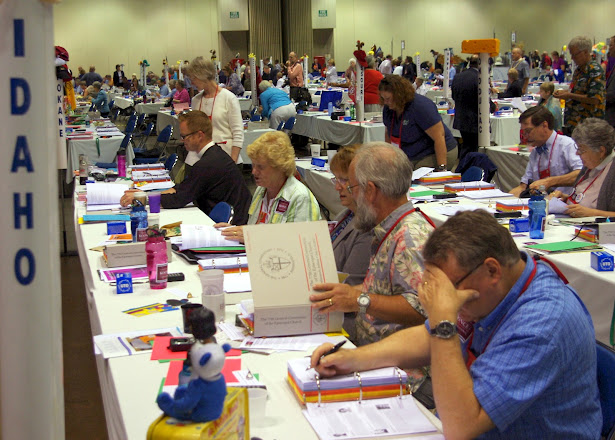
General Convention is also notable for its sheer
ostentation and carnival atmosphere. For seven straight nights, lavish
cocktail parties spilled into pricey steakhouses, where bishops could
use their diocesan funds to order bottles of the finest wines.
Alas if this were only true — I was present at the General Convention
from start to finish and somehow missed the bacchanalia he describes.
Among the nearly 5000 deputies, bishops, guests, exhibitors and members
of the press corps some may have had the wherewithal to host “lavish”
cocktail parties that moved on to “pricey steakhouses” - but they were
not bishops. The era of privately monied bishops ended some time ago.
It continues:
During the day, legislators in the lower chamber, the
House of Deputies, and the upper chamber, the House of Bishops,
discussed such weighty topics as whether to develop funeral rites for
dogs and cats, and whether to ratify resolutions condemning genetically
modified foods. Both were approved by a vote, along with a resolution to
“dismantle the effects of the doctrine of discovery,” in effect an
apology to Native Americans for exposing them to Christianity.
Yes, among the 600 resolutions brought to the convention there were
some odd items that were fatuous politically correct drivel — no
question about that. However, the church did decline to endorse
requiem masses for pets. But his next argument about the polity of the church — the way it orders its life — is false.
But the party may be over for the Episcopal Church, and
so, probably, its experiment with democratic governance. Among the
pieces of legislation that came before their convention was a resolution
calling for a task force to study transforming the event into a
unicameral—that is, a one-house—body. On Wednesday, a resolution to
“re-imagine” the church’s governing body passed unanimously.
Formally changing the structure of General Convention will most
likely formalize the reality that many Episcopalians already know: a
church in the grip of executive committees under the direct supervision
of the church’s secretive and authoritarian presiding bishop, Katharine
Jefferts Schori. They now set the agenda and decide well in advance what
kind of legislation comes before the two houses.
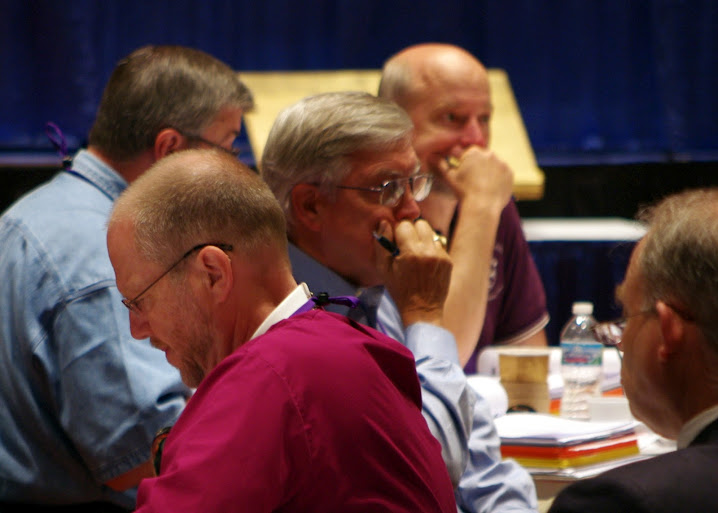
The
first assertion, that the church’s tradition of democratic governance
is in jeopardy, and the second, that a cabal controlled by the
“secretive and authoritarian presiding bishop, Katharine Jefferts
Schori” controls the convention are incorrect. While she has enormous
influence, the presiding bishop and her staff at the national church
offices in New York City have no control over “what kind of legislation”
comes before the two houses (as an aside it is the House of Deputies,
what the WSJ calls the “lower house” that is the senior of the two, not
the House of Bishops.)
Legislation in the form of resolutions can
be proposed
by the church’s national committees, bishops, any one of its 111
dioceses grouped in nine geographic provinces or by deputies to the
convention. To say the presiding bishop controls “what kind of
legislation comes before the two houses” speaks to a lack of knowledge
about the church’s legislative process.
There is also a “dammed if you do, dammed if you don’t” tone in this
article — the church is ridiculed for some of the silly things that are
brought to the convention and Bishop Jefferts Schori is accused of
controlling the legislative process which brings forth these silly
things. Which is it? Is she responsible for packing the legislative
calendar to achieve her nefarious ends, or is she responsible for the
froth and frippery that takes up so much of the convention’s time?
The article takes a turn away from the convention to pursue Bishop Jefferts Schori.
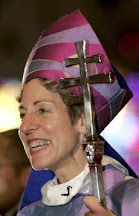
Bishop Schori is known for brazenly carrying a
metropolitan cross during church processions. With its double horizontal
bars, the metropolitan cross is a liturgical accouterment that’s
typically reserved for Old World bishops. And her reign as presiding
bishop has been characterized by actions more akin to a potentate than a
clergywoman watching over a flock.
I’ve witnessed two of her predecessors as presiding bishop carry a
metropolitan cross, and the one she is carrying in the photo appended to
the article was given to her by former Presiding Bishop Frank Griswold
at her installation — bit of an unfair dig. The article also takes up
the church’s property battles and money woes — pressing the conservative
line with some vigor, and then takes a bizarre turn — one that is a
dead giveaway that this author does not know what he is talking about.
And yet there are important issues at stake if laymen are
further squeezed out of what was once a transparent legislative
process. A long-standing quest by laymen to celebrate the Eucharist—even
taking on functions of ordained ministers to consecrate bread and wine
for Holy Communion, which is a favorite cause of the church’s left
wing—would likely be snuffed out in a unicameral convention in which
senior clergy held sway.
The assertion that lay celebration of the Eucharist is a “favorite
cause of the church’s left wing” is preposterous. It is not the left but
the right who has pushed for lay presidency. The chief
proponents of this change to the church’s teachings are found in the
Diocese of Sydney, Australia and among low churchmen — the most vocal opponents of Bishop Jefferts Schori within the wider Anglican world.
The
article moves from mistake to misstatement to mistake. The “entire
delegation” from the Diocese of South Carolina did not “storm out” — six
of the eight members quietly withdrew. South Carolina Bishop Mark
Lawrence
explained
to his colleagues why he felt called to leave early — his sadness at
the adoption of rites for the blessing of same-sex couples — but made it
clear that he, and the diocese, had not left the Episcopal Church.
And it is here that I have my greatest difficulty with this article.
There were a number of highly contentious issues before the General
Convention — the
authorization of local rites for the blessing of
same-sex unions, changing the requirement that a person
be baptised before they receive Holy Communion, opening the ordination process to
trans-gendered
persons. Yet the controversy over gay blessings and the compromise
reached within the church — a local option whereby it is lawful in those
parts of the church that support the idea and unlawful in those areas
that do not, and no priest may be compelled to perform such a ceremony —
is not mentioned at all.
The first mistake the author makes in this story is in not defining
his terms. What is a General Convention? What are its powers? This
question currently is the subject of litigation before the Texas Supreme
Court and lower courts in California and Illinois. Grounding the
article by stating the powers exercised by this gathering are in dispute
amongst Episcopalians would have been a better start.
However, the problem with the Episcopal Church is not cocktail
swilling bishops or a power-mad gargoyles peering down at the church
from a penthouse in Manhattan. Problems with alcohol and homosexuality,
money and power are derivative issues that arise from the divide over
the interpretation of Scripture and an understanding of the person of
Jesus Christ. The fight may take the form over secondary issues such as
morality of homosexual behavior or the role of women in the leadership
of the church, but it is based upon a division over who Jesus Christ is
and how Christians read, interpret and live out the teachings of the
Bible.
While I am sympathetic to much that has been said, the article was a
wasted opportunity to explain what really is going on. Reading “What
Ails the Episcopalians” will not leave you any the wiser — and that is a
shame. Just think what could have been done with this story, and was
not.
Written by: geoconger on July 13, 2012.

